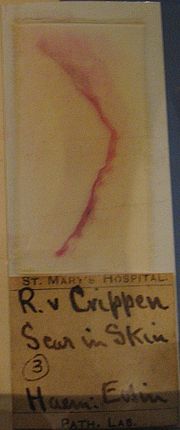
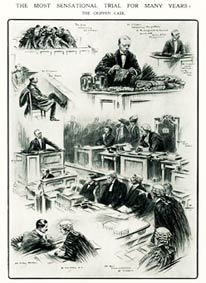
The Crippen case is filled with controversy. When the case went to trial, they did not have access to DNA testing, and if you tried to convict someone on the fact that a body has a mark that could be a scar or a fold in the skin, you would almost certainly be laughed at and had the evidence ignored for being insubstantial. Recent DNA analysis of Cora’s great-niece, Marie Hamel, performed by John H. Trestrail III, shows that the body buried underneath Crippen’s cellar was that of someone other than Cora, and it has been said that it may have even been the body of a male. Dr Foran, forensic scientist of Michigan’s State university, after finding the DNA evidence, said “When I saw the results I thought: ‘They got the wrong guy.’ It was quite amazing. I don’t know who was buried under Dr Crippen’s house, but it certainly was not his wife” Crippen’s 71 year old Descendent J. Patrick Crippen is petitioning the court to have him pardoned, and to have his body moved from Pentonville to the family plot. If Crippen is pardoned, it will be the longest miscarriage of justice ever, as Crippen was found guilty 99 years ago. It was also reported that “We have documentary evidence of a woman living in the US with Cora's relatives, with a name used on stage by Cora.” The source does not specify what stage name was used, but it was unlikely to have been Belle Elmore, as that name was publicized greatly during the trial, it was more likely to have been Cora Motzki, a name she used only briefly near the beginning of her career
The Evidence
The supposed “proof” of Crippen’s guilt would not be accepted in a court nowadays. Even though we now have definite ways of testing identity, even without that technology, no-one would accept a scar as proof of identification, at any rate, not a surgical scar, as who knows how many other women in London had had a similar operation. If the scar was from an accident, it could be accepted, but not on it’s own. It also seems completely illogical that someone who had the patience to cut up the body, dissolve the bones, remove the genitals and the head, would then just hastily bury it in the cellar. It does not make any sense that he would go to all that trouble to remove all the identifying marks, and then leave his shirt and some of the body’s hair down there in plain sight and leaving it in one of Cora’s hair curlers, and also, he kept the pants from the pyjama top, proving that it was his. The shirt however was in incredibly good condition for something that was buried in lime, next to or on top of a rotting body for four months. The final piece of evidence, and perhaps the one that could have saved Crippen, even if only for a short while, was the letter from Cora which, even though it may have been faked, could still have saved Crippen. But Winston Churchill, home secretary at the time, was given the letter and then supposedly forgot about it… for 99 years. It has been argued that he intentionally withheld the letter, as he was being pressured by the public to have Crippen executed, but if he was found innocent, with good reason, the people probably would not have complained. Indeed quite a few people would have been happy to hear that Cora was still alive
The Trial
When Crippen went to trial, it was already over for him, he had been stuck with Alfred A. Tobin, 'one of the dullest, most plodding advocates in the business', and he had already been tried by the media, which convinced almost everyone of his guilt, even his own solicitor, Arthur Newton, who tried to sell a forged confession to Horatio Bottomley, publisher of John Bull. The main witness for the prosecution was Bruce Miller, the man Crippen had said Cora had run away with. He said that while he and Cora were good friends, they had not been lovers, and he had not heard from her in years. Few people believed him, as they knew his wife was in the public gallery, but they still found him guilty. It is also reasonable to conclude that, since all people who said the mark on the skin was a scar had prior knowledge of the fact that Cora had had an operation to remove her ovaries, no-one can be sure if they really thought it was a scar, or if they just wanted to protect their reputations and win another case. It is entirely possible, that if Cora did not have a scar, they would have said it was a fold in the skin.