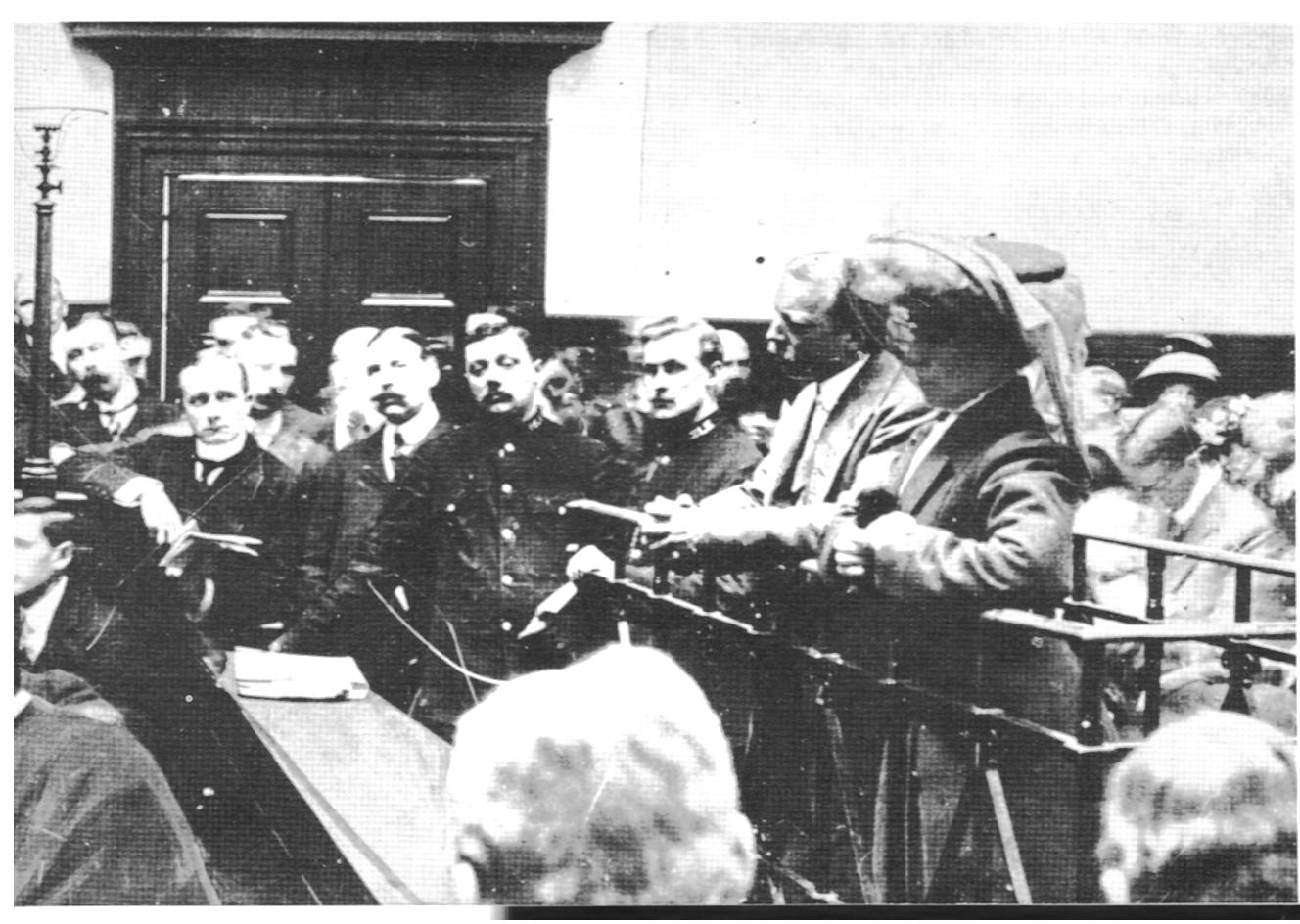
The trial commenced on the 18th of October 1910. Crippen was defended by A.A. Tobin, K.C. Mr. Huntly Jenkins, and Mr. Roome, while representing the Crown was; Mr. Muir, Mr. Travers Humphreys, and Mr. Oddie. His story was that after the party, Cora was very angry at him and had said that she was leaving and for him to “cover up the scandal in the best way you can”. He went to work the next day, and when he returned home Cora had vanished. In order to “cover up the scandal” he said she had gone to America and died of double pleuro-pneumonia, and later said that she was living with Bruce Miller, who they then had flown in from America to testify. He said that he had not seen Cora for years, although he may have been lying, as his wife was in the visitors’ gallery, and he may just want to avoid any embarrassment or scandal, which means Cora could have still been alive in America, it is impossible to tell. The next part of Crippen’s story is that he then had Ethel Le Neve move in with him openly, and only when the police came to ask questions did he realise that Cora’s disappearance could be interpreted in a sinister manner. Since he had lied about her death, they may have thought he was lying about her being alive as well, so he immediately left for Canada in disguise. Expecting to be arrested in Canada, he faked a suicide note so he could hide out till it was safe to rejoin Ethel. This story could have been true, but it did not explain the mutilated remains. Crippen’s defence case was that slaked lime preserves very well, and the body could have been there for years, long before the Crippens moved in. But this did not save him. With the body was found a pyjama top, a kind that was only made since the Crippens moved in, and Hyoscine Hydro-Bromide was found in the remains, and Crippen had purchased, not long before Cora’s disappearance, five grains of Hyoscine (300mg) such a large amount that it had to be purchased directly from the wholesalers. Sir Bernard Spilsbury, a forensic pathologist, regarded as a real life Sherlock Holmes was pathologist for the prosecution, and he believed that a mark on the skin, that could have been either a scar or a fold in the skin, was, without a shadow of a doubt, a scar from an operation that Cora Crippen had had done, while Gilbert Maikland Turnbull was pathologist for the defense, and he said it was merely a fold in the skin. While Spilsbury believed that the body was definitely that of Cora Crippen, below is a transcript of Turnbull and Spilsbury arguing over where the flesh came from, and whether or not it was a scar. Turnbull said it could not come from the abdomen because it was lacking a certain tendon, after which Spilsbury calmly used forceps to point out the ‘Missing’ tendon, after which turn bull said “It is not where I should expect it from the dissections I have made.” The Jury only needed to deliberate for twenty seven minutes before they came to the unanimous conclusion that Crippen was guilty. He was sentenced to death after a four day long trial, and hung on the 23rd of November 1910.